Whatever happened to Val Kilmer? Like many people of my generation, I have fond memories of Val Kilmer. I'm not talking about the volleyball playing, chiseled Iceman who shared such uncomfortably good screen chemistry with Maverick in Top Gun. I'm talking about the brilliant, charismatic, endearingly irreverent Chris Knight of Real Genius.
In The New Cult Canon, Scott Tobias revisits the most appealing incarnation of Val Kilmer and the zenith of the lovable nerd comedies of the '80s.
If there ever was a poster boy for the pitfalls of taking yourself too seriously it would be Val Kilmer, a bad boy forever on the run from his God-given ability to capture snarky sunshine on the silver screen and make the antisocial antipathy associated with genius a fiction as opposed to a reality.
Enjoy!
Showing posts with label Movies. Show all posts
Showing posts with label Movies. Show all posts
Tuesday, January 18, 2011


Thursday, January 06, 2011
In the Mood for Love: Five Fingers
I love running, but I hate running shoes. Running shoes never felt right. I'm not a shoe nazi. I couldn't imagine playing competitive sports without decent athletic shoes. But running should be different. It shouldn't be about encasing my feet in layers of rubber and fiber that have no purpose other than to stitch a logo on. It should be about the freedom to just get up and run. To anywhere. To nowhere. Just run.
Thursday, September 03, 2009
THIS is How Lovers Look!

When my wife and I paid our respects to Alexis Tioseco and Nika Bohinc last night at Capilla de San Francisco in Santuario de San Antonio, Forbes Park, Makati, we were overwhelmed by the number of people who came to mourn the passing of a lovely, talented couple. Their dedication to capturing and encouraging beauty and truth, twenty four frames per second at a time and every second they spent with one another, will truly be missed.
But you might want to give what passes for "news reporting" on the tragic killing of these beautiful people a pass. My friends and I are incensed at the gross insensitivity with which the two major nationwide news networks have treated the slaying of Eggy and Nika.
Those who know me also know that I always credit my sources whenever I blog. This time, however, I refuse to give these character butchers the satisfaction. ABS-CBN immortalized these fierce dreamers and the passion with which they loved each other by reporting:
A Filipino-Canadian film critic and his Slovenian live-in partner were shot dead inside their home in Quezon City, Tuesday night.
GMA 7 came up with the brilliant headline "Film critic, lover killed by robbers in Quezon City home" and provided video that showed digitally blurred footage of both Eggy and Nika sprawled on the floor.
It seems that these major news networks exhausted whatever compassion and sensitivity they had with their coverage of Tita Cory's passing. It's a shame that their humanity extends only to revered former presidents.
Sadly, the finest news reporting of Eggy and Nika's murders were provided by a smaller Filipino newspaper which I remember as having been a tabloid featuring scantily clad young starlets, foreign news agencies and movie blogs. If you want to read the heartfelt sorrow that our young friends' passing has caused, kindly check out fellow Filipino Jeffrey G. Damicog's remarkably sensitive news report in Tempo, and Kim Voynar's moving meditation on love and loss in Movie City News.
Oh, and people? The picture above is how lovers look. Just for future reference.
Photo Credits:
Picture of Eggy and Nika comes courtesy of Chris Yambing.
Wednesday, September 02, 2009
Requiescat in Pace Eggy!

One of the fondest memories I have of Alexis "Eggy" Tioseco was when we both attended the wedding of common friends in Cebu a year ago. Eggy was already by then a distinguished film critic and a passionate supporter of the nascent independent film industry in the Philippines. I kidded him that his taste in cinema was too elitist: if it was visually striking, narratively dense and required a panel of independent film critics simply to understand what it was all about, then it was Eggy's kind of film.
"Case in point, Eggy. You watch movies that practically require you to bring pillows, army rations and urine bags to the theater."
"That was for class. And it was a great film."
"All the films you like need a class to understand them. And it was a great film: for people who have cast-iron bladders."
"That's also why I don't watch Hollywood movies. I lack a cast-iron esophagus."
"You're a movie snob!"
"Steven Seagal. I've seen all his movies."
I stopped dead in my tracks. I motioned for Eggy to go on and explain, without having to go into too many actions that could disrupt the delicate fabric of cinematic space and time, how an otherwise reasonably intelligent and passionate cineaste could so thoroughly eschew the fine artistic and commercial films that Hollywood studios churn out on a semi-regular basis but have all the time in the world to go through the the filmography of the man who now does this:
And then Eggy started telling me of how his dad used to watch Steven Seagal's movies when he was younger, and, as he tried to find a more comfortable spot to watch the movie with his dad, how Eggy marveled at how such broadly sketched violence could bring his dad so much joy.
For Eggy, despite the fact that I think most of the movies he watched were primarily exercises in cinematic obfuscation, and how some people shouldn't be given a digital movie camera, ever, films were always an opportunity for him to recapture joy, however fleeting, however he can.
Rest in peace, my dear friend.
Photo Credits:
Picture of Alexis comes courtesy of his Facebook profile pictures.
Thursday, August 13, 2009
Acquired Tastes: Nicolas Cage?
It's very difficult to provoke my wife. By and large, Tina, and by extension (if only for the benefit of this short entry, the point of which we will be coming to shortly) my mother-in-law are the very picture of rationality, grace, and generosity.
Except when it comes to Nicolas Cage. When it comes to the subject of the Oscar-award winner for most ridiculous hair extensions in major studio releases, these two otherwise level-headed ladies can't help but dish out the vitriol.
One might be tempted to lump Nicolas Cage in with another polarizing Hollywood phenomenon like David Caruso. But unlike Caruso, whose impact on the thespic arts is negligible due to his insistence on punctuating every scene, regardless of dramatic effect or context with his eponymous sunglasses, Nicolas Cage is actually considered by many to be a rather talented actor.
As Nathan Rabin observed in his article on Cage's embarrassing, yet strangely compelling sexual thriller, Zandalee, Nicolas Cage is a brave actor, which is not always the best outcome for movies, or moviegoers in general:
A lot of people dislike Nicolas Cage because he makes so many terrible movies and does things like name his son Kal-El. I, on the other hand, love the guy. Think of all the gutsy, unforgettable performances he’s given through the years in movies like Valley Girl, Rumble Fish, Raising Arizona, Moonstruck, Red Rock West, Leaving Las Vegas, Face/Off, Bringing Out The Dead, Adaptation, Matchstick Men, The Weather Man, and Lord Of War. That’s lifetime-pass credentials for sure. And his Werner Herzog Bad Lieutenant movie promises to be great, wonderfully terrible, or both.
Like R. Kelly, even when Cage is terrible, he’s pretty terrific. You could even argue that when he’s terrible, Cage is especially awesome, on multiple levels. He’s a legitimately great actor. He’s also a great bad actor, a great crazy actor, and a great over-actor.
In the late ’80s and early ’90s, Cage’s primary criteria for choosing roles seemed to be:
How ridiculous will my accent be? Will it sound like a dialect never spoken by anyone, ever, in the history of time?
How about facial hair? Can it look like fake hair haphazardly placed on me by a blind man with an odd sense of humor?
Will I be called upon to shamelessly overact or go completely fucking nuts?
What do you think?
Enjoy! Or not.
Friday, April 24, 2009
Guilty Pleasures: Patrick Boivin!
How does one celebrate the end of a long week spent serving the different communities that I have willingly partnered with? Certainly one does not celebrate by enumerating the many gaffes, miscues, and trials that marred otherwise successful initiatives such as the Marriage Encounter Weekend in Tagaytay, Alpha International meetings in Kuala Lumpur, or the search for the perfect chicken rice in Singapore.
Rather, let me celebrate both my happy return to the Philippines and the nerditry that I have recently come to embrace by sharing the wonderful stop motion work of Patrick Boivin. Enjoy!
Friday, April 03, 2009
Guilty Pleasures: French Parodies
No sooner than I had posted Ralph's sincere, albeit strangely stilted account of our travails in Mindanao than I stumbled upon FilmDrunk's recommendations of several short French parodies of American movies. The short films were financed by Stella Artois as part of their Smooth Originals campaign.
Simone says "Simone is going to tell Inspector Meqlain what to do..."
“Say bonjour to your wife, female canine.”
The above quotations, of course, work only when performed with a servicable French accent. Enjoy!
Tuesday, March 10, 2009
Acquired Tastes: Benjamin Loong II on The Watchmen Movie
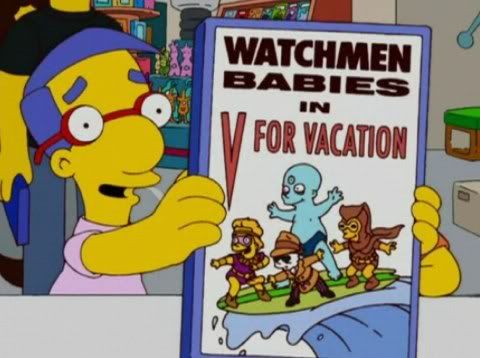
While I haven't found the time to see The Watchmen on the big screen, therefore putting my already precarious "uber-nerd" status in peril, fellow comic book fan and cineaste Benjamin Loong graciously provided me with his quick review of the big screen adaptation of one of Alan Moore's most influential works. Enjoy!
Watchmen movie review
By Benjamin G. Loong II
This review will be brief and not so detailed since I've only seen the movie once, on Thurday.
First of all the introductory scene featuring the murder of Edward Blake was just beautifully done. It was a brutal, well-choreographed fight scene that, I found, was a welcome addition. This was followed by an Easter egg-laden montage set to Bob Dylan's "The Times are a Changin'," which was used to set-up the alternate timeline of the world of Watchmen. It did so rather well in my opinion.
What follows is a faithful adaptation of the original story with some minor changes that were necessary for translation into film. The first half of the film rather excellent, in my opinion, but in the latter half the time constraints of the theatre release were quite noticeable: the film would jump from scene to scene while lacking any subtle transition at all.
The time constraints were possibly the cause for the film's other major shortcoming, which involved failing to develop several characters adequately, namely: Rorschach, Ozymandias, Bubastis, and the various minor characters who died in New York. With Rorschach I felt that the interrogation scene in the film did not adequately convey the character's psyche nor his philosophy. It managed to give hints of characterization, but not enough for people who never read the book to sympathize with the character. With Ozymandias the problem is similar as the film barely touched upon his origins, and while it does partially explain his motivation, other aspects of the character are not touched upon. As for Bubastis, no explanation is given for her existence and she just appears as soon as the story gets to Veidt's arctic reseacrch facility, Karnak. The minor characters were not given any characterization at all, leading to less sympathy for their deaths than what one would feel reading the comic. This omission was not as necessary to the story as the characterization of the main characters, but I felt it noteworthy. I mention these because the original story was essentially a character piece. It's central theme was the deconstruction of the idea of the superhero through and examination of the story's major characters. The main plot was just the framework around which this happened and failing to do so for any of the characters is a major shortcoming.
Another notable omission was that of the scene of Hollis Mason's murder, which had been filmed, but ended up on the cutting room floor due to time constrains.
Despite these shortcomings in the characterization of some of the characters, the acting by the cast for all of the characters was excellent. To borrow another reviewer's description, Jackie Earle Haley's Rorschach was “sublime.” Jeffrey Dean Morgan managed portray the Comedian in an incredibly sympathetic manner. And Matthew Goode, despite the reservation of some fans, managed to pull off Adrian Veidt so well that I barely noticed when his dialogue deviated from that in the novel. This was particularly true during the movie's climactic scene in Karnak. But perhaps the most impressive of all was Billy Crudup's portrayal of Dr. Manhattan. Perhaps this was because his was the character that had the most development, and thus gained the audience's sympathy the most.
Overall, I'd give it a 7.5 out of 10, and suggest waiting for the director's cut to come out.
Photo Credits:
Picture of the Watchmen Babies comes courtesy of The NERD of HER!
Friday, May 09, 2008
Jimmy Jams on Alpha
 We just held the introductory dinner for our NAO Alpha Course last night. Despite the inclement weather, we had a grand old time, mostly at my expense. Kudos to my loving wife Tina and my best buddy Ralph for making the dinner a truly special occasion. If anyone else is interested, our first regular Alpha session will be held next Thursday, 7:15 pm, at the NAO (17-A, General Atienza, San Antonio Village, Pasig City). Please e-mail Ralph Lumo at ralph@alphaph.org for more details.
In more Alpha related news, Jimmy Tubeo just posted this lovely update at the Alpha Friends site. Incidentally, Jimmy will be bringing his taciturn brilliance to Manila sometime soon, where he will try to demonstrate how people confronting their Omega can find renewal doing Alpha. Thanks for the post, Tito Jimmy!
And finally, in non-Alpha related news, which must come as a relief to my regular readers, here are some interesting movie-related articles that I got to read courtesy of our vigilant friends at Fark. One is on movie comebacks that didn't quite take, and some of the most memorable drunks in movie history.
Enjoy!
Monday, April 28, 2008
Pacino's Way
 Unlike De Niro, cineastes have been kinder to Pacino. According to our wonderful friends on Fametracker, which, sadly, is still on hiatus, the reason for that is simple. Read on:
How many actors of Pacino's stature still work so hard to entertain you? Wait a second -- how many actors are there of Pacino's stature, period? Only three Method giants survived the '70s unhobbled: Pacino, De Niro, and Duvall. All inarguably brilliant, each now following his own path. For Duvall, that means writing, directing, and starring in his own small, interesting films, such as The Apostle (with the occasional paycheque cameo in Gone in 60 Seconds). For De Niro, that means Rocky and Bullwinkle -- i.e., a long and leisurely retirement spent doing the same tics and twitches in about fourteen films a year, his rent-a-behind now firmly situated on his laurels.
Pacino, however, is working harder than ever. He works so hard, he spits. Think about it -- he's actually ramped up the energy since he started. His breakout role was as the near-somnambulant Michael Corleone, a guy who barely raised his voice. Fifteen years later, the older Pacino was tearing through every part like the hyperactive love child of the Tasmanian Devil and Cosmo Kramer.
I, for one, continue to hold out the hope that precisely because he works so hard, eventually good old Al will eventually come around to producing quality stuff. Till then, we ought to sit back and relax. He might not be hitting a very high percentage, but one of the hardest working actors of his generation remains one of the singular entertainment acts of all time. Let me leave you, therefore with another excerpt from our sadly inactive friends at Fametracker:
One of the more curious footnotes to the career of Al Pacino is that he was offered, and turned down, the part of Han Solo in 1977's Star Wars.
Now take a moment to imagine this: the young, pouchy-eyed Pacino reclining in the captain's seat of the Millennium Falcon, enjoying a moment with Chewie. Or the young, pouchy-eyed Pacino shouting "Hoo-wah!" as he zips like a frenetic elf up the ramp of the Falcon, trading blaster shots with attacking stormtroopers. Or the young, pouchy-eyed Pacino flying in like the cavalry in the film's climactic battle and, just before sending Vader's TIE fighter spinning madly into space, screaming, "Shay jello to my wittle vrend!"
Now, we're not saying that this would have been a better movie. But it sure would have been a more interesting one.
Which, really, is the best thing you can say about the very, very great Al Pacino. Or this: If you had to choose the films of one modern actor, and only one, to take with you into desert-island exile, whose oeuvre would you choose?
We submit Al Pacino. Here, you get cinematic art (the first two Godfathers; Dog Day Afternoon); you get high quality, high-satisfaction treats (Glengarry, Glen Ross, The Insider, Donnie Brasco) and you get delicious, delirious cheese (Scarface, The Devil's Advocate, City Hall). What more do you and your volleyball companion need? And, though we haven't seen every single Al Pacino movie, we are confident in asserting this: There's not a boring frame among them.
Enjoy!
Thursday, April 24, 2008
The Search Goes On: De Niro and Pacino
 My good friend Ella Ampongan mailed me an article in the Los Angeles Times which chronicles the thespic fall from grace of both Robert De Niro and Al Pacino. Now, much like many Filipinos' morbid fascination with vehicular accidents, the descent, by two of the finest actors of their generation, into crass commercialism and unbearably ponderous vanity projects, is something I can't stop writing about. Before I embarrass myself by asking if longtime readers of this blog remember the times when I lamented the fate which these fine gentlemen seem to be hurling themselves to, let me just move on and provide links to fellow cineastes who can't help themselves as well. Here's an oldie on from the wonderful people at Fametracker on Robert De Niro:
When did Robert De Niro stop acting? And when did he start saying yes to everything?
Granted, he's never terrible. In fact, that seems to be his biggest problem. He can show up, do his schtick (the squinting, the shrugging, the head bobbing from side to side), collect his check, and head home.
But when was the last time he surprised you? We don't mean surprised by his choice of role - as in, "De Niro's in Rocky & Bullwinkle !?!?!? Really!?!?!" - but surprised by what he did with the part.
Sam Rothstein in Casino was just an echo of Jimmy Conway in Goodfellas -- which was itself an echo of better work in Raging Bull and The Godfather Part II. Ditto for his parts in Cop Land, Heat, and Jackie Brown. He was intense as Dwight Hansen, the menacing stepdad in This Boy's Life, but hardly revelatory. How about Max Cady, the tattooed psycho in Cape Fear? Or maybe Stanley of Stanley & Iris?
Folks, those roles were more than ten years and twenty-five films ago. Yes, you read that right. Twenty-five films.
Or have you forgotten Backdraft, Sleepers, Night and the City, Mad Dog and Glory, Analyze This (and, while you're at it, That) Heat, The Fan, Great Expectations, Men of Honor, Meet the Parents, 15 Minutes --
15 Minutes (!?!) --
The Score, Ronin, Showtime --
Showtime (!!?!!)
City by the Sea, Godsend, and, finally, the just-opened Shark Tale.
Excuse us. We need to sit down and catch our breath.
It's some kind of testament to De Niro's -- what? Longevity? Reputation? Savvy? Greed? -- that he's managed to make more bad movies in the last decade than most actors have made movies, period. And we know what you're thinking: Those movies weren't terrible, with the exception of Showtime, 15 Minutes, and a few others. Meet the Parents? Funny. Heat? Thrilling-ish. Ronin? Downright serviceable.
Yes, sure, fine. We concede that. We like to see an urn full of someone's mom's ashes smashed in the fireplace and then sniffed at by a fuzzy cat as much as anyone.
But don't you remember when Robert De Niro showing up in a movie was an event? When it meant something? We're not even talking about his heyday as a live wire in the '70s, when he crackled with such committed intensity that he fried every other actor on the set. (Joe Pesci has a made a whole career out of the simple ability to appear onscreen with De Niro and not get sizzled to charcoal.)
We're talking about the 1980s. Hell, even the early '90s. We're talking about a time not that long ago. Back when you'd hear about a film like, say, The Untouchables, and think, "Hmmm." Then you'd hear De Niro was playing Capone -- and packing on the pounds and shaving back his hairline to do it -- and you'd think, "Hey! De Niro! Now that's the stamp of quality!"
Robert De Niro is no longer the stamp of quality.
There's something undeniably ironic about the fact that a generation's most famously committed actor -- the guy who got fat for Raging Bull, the guy who'd self-inflict any physical degradation in the name of his beloved Method -- should spend his retirement as, arguably, the laziest and most formulaic movie star in Hollywood.
To Ate Cecile: yes, I realize that the picture above has nothing to do with the post. And yes, I'm doing Pacino tomorrow. Enjoy!
Tuesday, April 22, 2008
Call Off the Search Party: Steve Martin
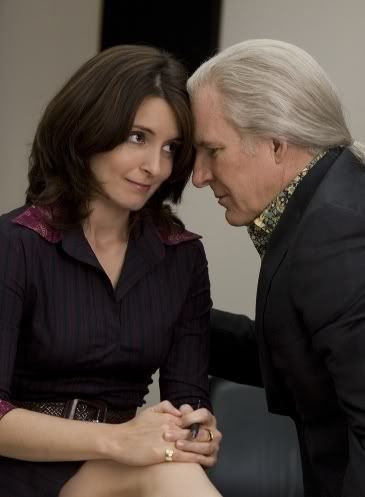 There are some actors who you simply can't watch, unless a misplaced sense of Catholic guilt requires you to do penance by sticking the metaphorical equivalent of a poniard into your eyeballs. Case in point? David Caruso. His heavy-handed, over-modulated, Ray-Ban driven delivery (and seriously, has any other actor relied so heavily on a pair of shades to fake gravitas more than this hack?) always makes me reach for the remote.
And then there is Steve Martin. Steve Martin too makes me want to reach for the remote, but in a different way. It's just too painful to watch the comedic genius who brought us so much joy with movies like "The Jerk", "All of Me", and "Roxanne" sully his reputation with sterile, soulless fare such as the sequels to "Father of the Bride" and "Cheaper by the Dozen", both of which enjoy maddeningly constant airtime on our cable movie channels. How could the author of "Shopgirl" stoop so low? Perhaps he suffers from De-Niro-itis, where, having established himself as one of the most gifted talents ever to grace the silver screen, he feels that it's okay to never say no. Even if it means having to do The Adventures of Rocky and Bullwinkle.
Which is why, in the greater scheme of things, it was great to read the following excerpt from noted New Yorker critic Anthony Lane's review of "Baby Mama":
If you want to see scene-stealing turned into grand larceny, watch Sigourney Weaver, as the owner of the surrogacy service, or, better still, Steve Martin, as the presiding genius of Round Earth. Hand the guy a thick hank of ponytail, relieve him of the burden of a central role, aim him squarely at the bull’s-eye of eco-smugness (“I’ve toasted pine nuts on the edge of an active volcano”), and you find him happier onscreen than I have seen him in years. Who cares whose baby is inside which mother, when the laughs come from the grown man doing business with his inner child?
It's not exactly the Steve Martin vehicle that I want to see, but it's nice to hear that doing all those hack jobs hasn't blunted his skills too much. Now, if only we can stop him from doing the sequel to "The Pink Panther"...
Photo Credits:
Picture of Steve Martin and Tina Fey comes courtesy of About.com: Hollywood Movies.
Tuesday, March 18, 2008
Acquired Tastes: I Watched This On Purpose
 Every once in a while, I have to fight the urge to be contrary, just because. This willful turn towards contrariness oftentimes rears its head in the face of critical commentary, or commentary that carries with it the snap, crackle and pop of especially active synapses struggling for synthesis. Mostly, I fight the urge to be contrary whenever critical opinion reaches some sort of consensus.
 I think:
"What if all these experts and intellectuals were somehow wrong?"
Then, I gloat:
"Who's the smart one now?"
Josh Modell posits the same subversive slant in what is hopefully a series of short articles on movies that critics might have panned unfairly. Here are some excerpts:
We at The A.V. Club—writers and readers—are imperfect culture warriors, knowledgeable of what we should like and its relation to what we actually like, but even so, we aren't always impervious to the sexy allure of ostensible garbage. Sometimes—frequently, even—a movie or TV show will actually have cartoon stink lines emanating from it, yet we can't stop ourselves from seeing it. It's all about that kernel of hope, that faint possibility that this will be the one in a hundred that all the critics—and our own instincts—were wrong about. Thus is born I Watched This On Purpose, a new feature that will explore the impulse to spend time with entertainments that are unlikely to reward us in any meaningful way, or sometimes any way at all. It isn't a matter of getting to know your enemy, or even of discovering guilty pleasures, but of playing the long odds in hopes of a real reward. And a good time.
The first movie? The Timothy Olyphant starrer, Hitman. Good times!
And yes, Ate Cecile. The picture has nothing to do with the post. You love it anyway!
Tuesday, March 04, 2008
A Curious Case for Elevation to Prime-time
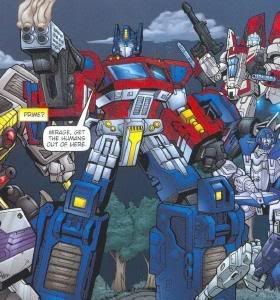 While I didn't have the opportunity to watch the recently concluded Oscars, I'm glad that much like this year's artistic output in film, the commentary on the awards, both real and "imagined" was of a similarly high quality. How else does one explain Chris Carlisle's impassioned plea for the recognition of '80s cartoon icon Optimus Prime?
Choice excerpts include:
The reason I’m not watching this year is because I am boycotting the broadcast due to the omission of a deserving nominee in the best actor category. This actor’s performance encompassed physically demanding stunts, displaying ranges of emotions from sorrow to happiness, and working under extreme conditions with minimal direction. His display of thespian mastery was truly one of the greatest on-screen performances this past year, if not the decade. In spite of all this and for reasons I cannot comprehend, Optimus Prime was shut out of the best actor category.
Oh I know what many of you are thinking right now. “But Chris, Optimus Prime isn’t real.” You know what I say to that? Shut up. Shut right the hell up with that talk. Optimus Prime is more real than any of the other actors up for award this year. I’ll tell you who’s not real. Johnny Depp. He’s a complete CGI creation. How else do you explain that he hasn’t aged since appearing in the original Nightmare on Elm Street almost 24 years ago?
As far as acting chops go, Optimus Prime has Depp beat hands down. The same goes for George Clooney, Daniel Day Lewis, and the rest of the best actor nominees. While I can’t say that I’ve seen the films of any of the nominees up for best actor this year, I’m willing to wager that none of them were required to battle 30 foot robots or even turn into a truck. Speaking of which, can Clooney turn into a truck? Can Lewis or Depp? Pshaw! Talk about limited range.
Have a nice day! And visit Chris Carlisle's site. You won't be sorry you did.
Photo Credits:
Picture of Optimus Prime comes courtesy of Wikipedia.
Tuesday, November 27, 2007
Wait, I'm on Cruise Control?
 I was looking for something more in keeping with the holiday season, but I came across this in Cracked, and I just had to share it with you guys:
"What are the chances that this poor woman winds up on a vehicle that gets hijacked by a crazy terrorist played by an actor too good for the role twice in her life? Really, if your trip gets interrupted by a guy with a bomb as second time, the problem isn't terrorism. It's you.
Jason Patric plays Annie's useless cop boyfriend, a role that was clearly written for Keanu Reeves and thus probably contained directions to react to every situation with an expression of dull confusion.
Of course, the most glaring problem is that the movie is called Speed and yet takes place on a cruise ship, the slowest form of transportation ever devised by man. Will Speed 3 be about a bomb on a hot-air balloon? A donkey? A Segway scooter? It almost seems like they came up with the clever 'Cruise Control' pun in the title, and wrote the movie around it."
Holiday cheer can wait. Commentary on a movie this ridiculous can't.
Photo Credits:
Picture of Speed 2 comes courtesy of Internet Movie Poster Awards Gallery.
Thursday, November 08, 2007
Adaptations: Books and Movies
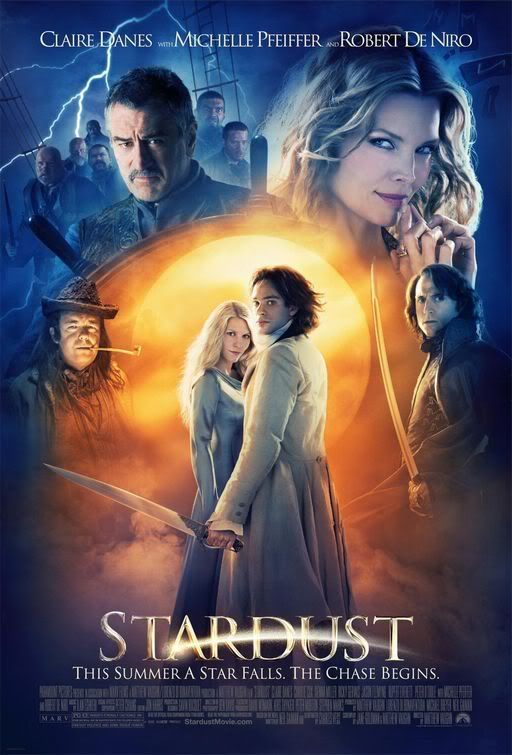
When I was younger, I really enjoyed Breakfast at Tiffany's, but while the ethereal Audrey Hepburn remains a timeless, incandescent angel, I cringe every time I hear Mickey Rooney's embarrassing Japanese caricature. I haven't caught Stardust yet, but if the best thing about the movie is that ham Robert De Niro's performance, then that's just sad. I have fond memories of what is, to my mind, Gaiman's sweetest prose work.
Photo Credits:
Stardust poster comes courtesy of Internet Movie Posters Awards Gallery.
Friday, July 06, 2007
The Original Transformers: More than meets the Eye?
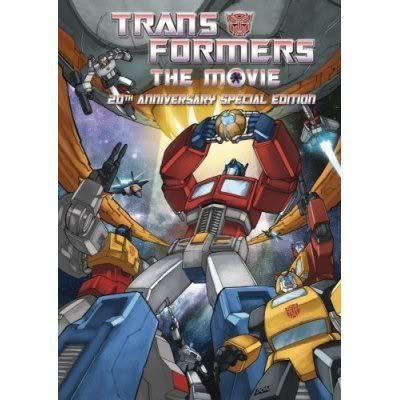
At any rate, let me share an interesting article by Slate writer John Swansburg on Why the original Transformers movie is better than Michael Bay's, a title that will live on in my short term memory as one of the most artlessly, but laudably blunt feature articles ever to come from Slate writer John Swansburg on the original Transformers movie. While Swansburg has, as of this writing, yet to construct, even upon revision, a coherent argument regarding the merits of the original Transformers movie with the one by Michael Bay, I appreciate his insights on how the death of Optimus Prime in the former was a significant event for teenagers of all stripes:
Only in our wildest dreams did we think that the show might celebrate its liberation from network television by letting loose with a curse word. And only in our scariest nightmares would we have imagined that a mere 20 minutes into the movie, Optimus Prime, the most beloved of Autobots, would be killed by Megatron.
To use a phrase I learned the day I saw Transformers, "Oh, shit!" No one ever died in these shows. Even in G.I. Joe, a cartoon about a special U.S. Army strike force, no Rattler was ever shot down without the pilot first safely ejecting. But in the Transformers movie, the death toll was jaw-dropping. More than a dozen marquee characters are dispatched in the film, among them one of my personal favorites, Starscream, the Decepticon malcontent always scheming to relieve Megatron of his command.
Despite my poor understanding, at the time, of the even more gruesome reality of a media-generated wave of crass consumerism, I was genuinely touched by Prime's sacrifice, and was drawn in eagerly to the rather quaint storyline that detailed the Autobots' quest for a successor. Swansburg goes on:
It's funny to listen to the filmmakers on the DVD talk sheepishly about killing off all of those characters, Prime in particular. They genuinely regret it. But in watching the movie again as a grown-up, you realize that Hasbro's profit motive had the unintended consequence of forcing the movie to tell a much more sophisticated story than might otherwise have been possible. With Prime off to the great scrapheap in the sky by the end of the first act, the movie becomes one about finding a leader who can take on Prime's mantle and defeat not just Megatron, but also Orson Welles' Unicron, eating his way through the galaxy. And in a nice mythic twist, Prime's successor turns out to be an Autobot no one—not even Prime—thought it would be.
Despite the technological innovations that allow the spectacle that is Michael Bay's Transformers to become a reality, some people still prefer the mythic permanence of the water and ink stained cels in, funny enough, Orson Welles' Transformers.
Photo Credits:
Poster of The Transformers - The Movie (20th Anniversary Special Edition) (1986) comes courtesy of Amazon.
Thursday, June 28, 2007
Summer Movies and Eternal Questions

1. An almost-relieved Dana Stevens, who celebrates the return of brawny, '80s style action movies such as Live Free or Die Hard. I can understand how the all-too grim realities of severed limbs and faces reduced to so much hamburger hash can make one long for the indestructible heroes of yore. I will admit though that my tastes lean more to Willis' John McClane rather than Stallone's John Rambo, an inclination that is addressed partially by...
2. Eric Lichtenfeld, who joyfully dissects the evolution of McClane's classic one-liner, "Yippee Ki Yay Mo—." Licthenfeld insists that, and I apologize if, by way of quoting Licthenfeld properly, I offend anyone's sensibilities:
A quarter of the line (or half, depending on how you count) is profane, and yet "Yippee-ki-yay, motherfucker" is actually a delicate wisecrack. Underscoring the line's bridging of generations is the symmetry of its construction. On either side of the comma, past and present each get four syllables. This balance is manifested in the evenness of Willis' first—and best—delivery of the line. Subtly, he eases off "fucker," the word that, by virtue of its syntactical position, and its very nature, we might expect to land hardest on our ears. That Willis does not employ the same deftness in the sequels is a pity. The phrase is most effective not as a buildup to some hammer punch, but as one seamless unit of defiance.
3. Which leads us, in the disjointed, barely rational, associative way in which random items are strung along together to "mean" something, to Marisa Meltzer's observations regarding stoner movies, an article that sadly, receives more column space than...
4. Matt Feeney's remarkably lucid analysis regarding the misconceptions regarding loving masculinity and homoeroticism in movies. Feeney writes:
A good way of grasping how the claim of homoeroticism misfires sociologically comes from a more recent example: the Spartan blood bath 300. Critic after critic sneered that 300 was transparently homoerotic. Blogger Andrew Sullivan approvingly cited a (presumably gay) correspondent who wrote, "Everyone in the film is gay." Why? Because of those short shorts and all those exposed muscles. (The correspondent dug the movie because of the hot, sweaty men. Ergo, everyone dug the movie because of the hot, sweaty men. I hope the entanglement of this interpretation in a hermeneutic circle is obvious.)
Now, 300 has earned more than $200 million in America alone, from an overwhelmingly male audience. What more plausibly accounts for this? That 20 million closet cases snuck off to see an illicit fantasy about bare-chested men in Hellenic Speedos, or that young men from the vast heartland of this very conservative, Christian, pro-military country flocked to see an unabashedly heroic tale of Occidental, republican military glory? To believe the latter, all you have to accept is that, in imagining the sort of heroic figures they themselves would like to be, straight men would project onto them not just excellence but physical beauty. Shouldn't a guy be able to do such a thing without being called gay?
Photo Credits:
Illustration of Bruce Willis as John McClane is by Deanna Staffo.
Thursday, June 21, 2007
A Mighty Heart

But, on to the review. Mr. Lane insists, celebrity and notoriety to the contrary, that Ms. Jolie is an actress. This assertion need not have been made should Ms. Jolie continued to star in movies in the vein of Girl, Interrupted, but one that needs to be repeated lest we lose Ms. Jolie completely to a world of celebrity and notoriety that threatens to consume her, or worse, "brand" her. Here are some choice passages from Mr. Lane's review:
Mariane is French-speaking, with a Cuban mother, and Jolie is equipped with corkscrewed hair, tinted skin, and murmuring accent. We brace ourselves for a star turn, a hundred minutes of vanity project, but here’s the thing: it never happens. Jolie slips into the part, ducks in and out of the action, and generally plays second string to the onrush of events. Blessed with the world’s most recognizable mouth, she confines herself to a single, skeptical pout...
Only once does Mariane crack. Informed of her husband’s death and of its savage circumstances, she goes to her room, crouches over, and keens. It could be the howl from a Greek tragedy, except that our heroine is not disporting herself on a stage, majestic in her grief, but filmed from so close that you can count the knobs of vertebrae at the top of her spine. By this time she is heavily pregnant, and her screams are a terrible parody of birth pangs—an echo that Winterbottom makes explicit, without needing to, in the closing scenes. This hasty, high-intensity, barely consolable film is just the kind of tale on which he thrives—and, more surprisingly, on which Jolie will come to depend if she wants to keep her head above the tides of madness in which, partly on her own initiative, she has chosen to float. Will success spoil Angelina Jolie? Not yet. Can she help it? Yes, she can.
Angelina Jolie. Actress. Who'd have thunk? Sadly, not a lot.
Credits:
Illustration of Angelina Jolie in "A Mighty Heart" by Lara Tomlin. The image comes courtesy of The New Yorker.
Tuesday, March 20, 2007
Acquired Tastes: Anthony Lane
 In my posted comments on Jason de Villa's elegantly informative entry on magazines worth checking out, I wrote:
Thanks for the heads up on Esquire. I checked out some back issues and in terms of content and fluid layout design, it’s top notch. I still prefer my The New Yorker, but I suppose it’s because I’m horribly sentimental, and a little Anthony Lane is better than no Anthony Lane at all.
To which Jason replied:
John-D: If you weren’t my friend I would say “What a literary snob!” Haha!
Well, allow this literary snob to point you in the direction of a more insightful, bitingly intelligent, and wonderfully witty snob, Mr. Anthony Lane. In his latest review, Mr. Lane takes on Adam Sandler in "Reign Over Me" and Sandra Bullock in "Premonition", much to the delight of this, admittedly, snobbish Lane fan:
Of all the things to make you pause, hand on wallet, before shelling out for a movie ticket, try this: a film about the aftermath of 9/11, starring Adam Sandler. What possible cultural need, one might ask, could be met by such a project? It is thus with a degree of amazement that I find myself nominating “Reign Over Me,” written and directed by Mike Binder, as a movie that might be worth your time.
Later, he makes some rather telling points regarding Sandler's startling effectivity in some decidely un-Happy Gilmore cinematic fare:
I cannot remember laughing at a single scene of his comedies, but here, for once, his chosen persona—the slurring and disconnected goofball—makes sense, although I still think of him as an oddly hollow presence on which to build a movie. His grief is less convincing than his vacancy, and one effect of “Reign Over Me” is to make you ask, Who will improve on Sandler?
I rather like Sandler's occasional flirtation with what could be considered good movies, like Spanglish and the decidedly un-Happy Gilmore art-house movie, Punch-Drunk Love. He might be an actor of very little range, but perhaps it is that sort of "hollow presence" and "vacancy" that allows talented storytellers to use him to tell good stories, where his celebrity is used to attract people to stories largely bereft of the distraction of an overwhelming star presence. Didn't this same quality make Keanu Reeves indispensable in The Matrix?
Illustration of Adam Sandler and Don Cheadle is by Edel Rodriguez, from The New Yorker.

