Showing posts with label Books. Show all posts

Thursday, March 10, 2011

Bad Writing? Good Parenting!

The Secret of the CavesImage via WikipediaSometimes, the worst writing conceals the best of intentions. I learned this from Gene Weingarten's heartwarming article on the man behind the popular Hardy Boys series, Leslie McFarlane.

Weingarten first writes of how he felt betrayed by the unbearably bad writing that characterized the adventures of his boyhood heroes, Frank and Joe Hardy:

"The dialogue is as wooden as an Eberhard Faber, the characters as thin as a sneer, the plots as forced as a laugh at the boss's joke, the style as overwrought as this sentence. Adjectives are flogged to within an inch of their lives: 'Frank was electrified with astonishment.' Drama is milked dry, until the teat is sore and bleeding: 'The Hardy boys were tense with a realization of their peril.' Seventeen words seldom suffice when 71 will do:
'Mrs. Hardy viewed their passion for detective work with considerable apprehension, preferring that they plan to go to a university and direct their energies toward entering one of the professions; but the success of the lads had been so marked in the cases on which they had been engaged that she had by now almost resigned herself to seeing them destined for careers as private detectives when they should grow older.'

Physical descriptions are so perfunctory that the characters practically disappear. In 15 volumes we learn little more than this about 16-year-old Frank: He is dark-haired. And this about 15-year-old Joe: He is blond.

These may be the worst books ever written."

Tuesday, September 15, 2009

Art That Renews: Kings, and The Privilege of the Sword


In his eulogy for our dear friend Alexis Tioseco, Paul Dumol thanked Alexis for his indefatigable efforts in championing cinema's finest undiscovered marvels "because art revitalizes, and every time I watch these films and experience the grace which art brings, I will be thankful for your persuasive enthusiasm". While my taste doesn't run to the sophisticated artistic fare that my colleagues bravely consume, I have come across some lovely works of art that could bear, in lieu of the graceful oblivion they are currently consigned to, the burden of more notoriety.

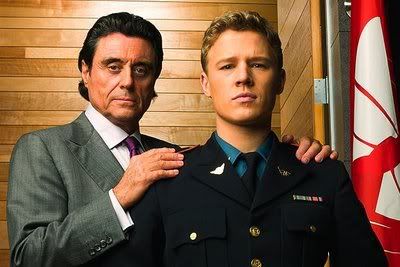
First, and more closely related to the medium that both Alexis and Paul adore, is the recently cancelled NBC series, Kings. A modern-day retelling of the story of King David, Kings is one of the few high concept projects involving the Christian faith that achieves a scope and power of truly biblical proportions. This series doesn't just boast sophisticated political drama, a rivetingly familiar vision of the modern world as a monarchy, or sophisticated narratives that largely succeed in making us care for characters based on well-trod biblical archetypes. It boasts, in my humble opinion, some of the finest actors and actresses currently working in television today. Reverend Ephram Samuels, played by Oz alum and critical darling Eamonn Walker, is alternately mellifluously soothing and quietly damning as the cleric who helped make, and will help unmake, a king. Brian Cox, as King Silas Benjamin's deposed predecessor, in the smattering of episodes that he appears in throughout the series, elevates all his scenes to a veritable master class on acting.

But this show belongs to Ian McShane, and rightfully so. As King Silas Benjamin, McShane gives one of the most indelible, forceful, elegant, and nuanced portrayals of a monarch in recent memory, in any medium. There are some fine, critically acclaimed Shakespearean performances of King Lear that were obliterated from my conscious memory by the performance that McShane gives here. No one radiates the fierce individuality, selfish sense of obligation, and pathos present in all human monarchs like McShane. His performance as King Silas is the axis upon which all the fine performances on Kings hinges. Without him, the terribly delicate conceit that informs the show's premise, would have fallen apart in the first episode alone. Truly remarkable.

Second, I just finished Ellen Kushner's fantasy novel The Privilege of the Sword, another delightfully understated, yet wholly subversive reconceptualization of a tired old literary genre. There is no magic in Kushner's world. Moreover, this is a world that doesn't need to be saved, at least in the grand, cosmic, earth-shattering way that previous forays in high fantasy always demand. Rather, we have a rambunctious, breezily literate, wickedly fun comedy of manners, only with swords in the place of the rapier wit that characters in such comedies seem to wield with equal efficacy.

Yet at the heart of all the polished repartee and the clever attention to social conventions that characterize a comedy of manners, there lies well, heart. The characters, which include an impoverished junior noblewoman forced to work for her seemingly mad uncle, the said mad, yet frustratingly intelligent and disturbingly kind yet cruel uncle, and an urbane young servant who is not below engaging in behavior just a hair's breadth above that of a guttersnipe, are not all quite the paragons of virtue that high fantasy requires, but their resulting stories of even partial redemption, are what all good coming of age tales live on.

Enjoy!

Photo Credits:

Picture of Kings comes courtesy of What's Alan Watching?

Tuesday, August 25, 2009

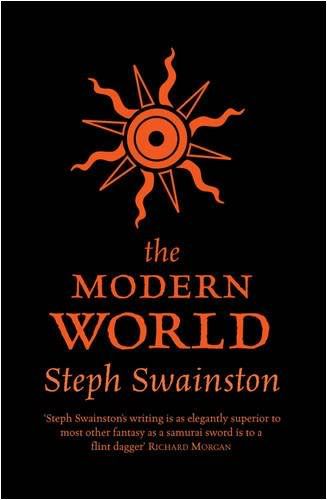
The Modern World: New Weird or Too Weird?


One of the reasons I loved spending time in London, other than the food, was the opportunity to browse through their wonderful book shops. While some of my beloved bargains were the product of many hours of sifting through the many different thrift shops scattered liberally around the city, at least one of the books I brought home was found in decidedly more urbane surroundings.

Prior to embarking on a writing career, Steph Swainston was a qualified archaeologist who spent some time as an assistant researcher in a firm that seeks to develop more medical applications for cannabis. Her writing, as such, is both rivetingly romantic (in the classical sense of the word) and mind-numbingly trippy. It is the almost hallucinogenic loveliness of her fully fleshed out, yet at times, spiritually emaciated characters and the strange worlds that they inhabit that have prompted critics to label her as one of the finest proponents of the New Weird. Her mixture of science fiction and fantasy, sprinkled liberally with the more ersatz elements of Jack Kerouac's road fantasies almost defies convention. When I picked up her first book, The Year of Our War, the feeling of alienation generated by the willful suspension between two well-worn literary genres almost wore me out. Happily, I shook off the disorientation and soldiered on. I haven't looked back since.

The premise is rather straightforward. A benevolent Emperor sustains the three humanoid races that populate a medieval world with the help of a circle of fifty immortal warriors. These immortal warriors are the very best at what they do, and they remain immortal for as long as they continue to prove to be the best at what they do. Jant Shira, also known as Comet, is an Immortal who is horribly addicted to a hallucinatory drug called "cat." He is also, due to his mixed heritage, the only being in the world who can fly. Comet, the Messenger, finds out that taking enormous amounts of "cat" allows him access to an alternate universe, where he has discovered the Insects' secret. Unfortunately, his ability to make use of this information is hindered by the fact that when his addiction to "cat" is threatening to consume what is left of his ability to be the Messenger.

While the prose often struggles to approach the rarefied heights that Jant scales so easily despite his addiction, it is serviceable, and the audacity with which Swainston carves out worlds just a degree or two north of what could be termed sane is truly entertaining. I would recommend this series for anyone who wants their epic science fiction fantasy kick to contain something a little stronger.

Photo Credits:

Picture of The Modern World comes courtesy of Dave Brendon's Fantasy & Sci-Fi Weblog.


Thursday, May 28, 2009

Acquired Tastes: Scott Lynch and The Lies of Locke Lamora


It's been a difficult day. In between waiting for news regarding the release date of my machine readable passport and dozing off due to my medicines, I haven't been able to function at peak effectivity. Since I have all this weird, oddly-timed bursts of energy, I've decided to share an author and series that I've been enjoying lately.

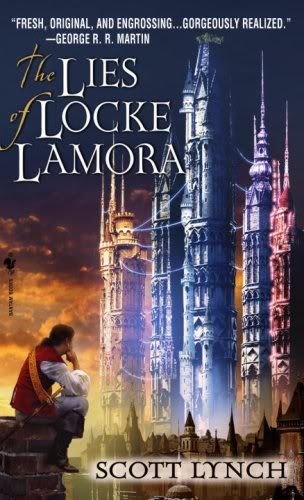
The fantasy novel The Lies of Locke Lamora is what happens when you take the finest heist elements of Steven Soderbergh's Oceans movies and marry them with a richly imagined, Renaissance-inspired universe that unfolds with all the swashbuckling economy of Steven Brust's Khaavren Romances.

The novel is a delightful romp, and hints at a fully-realized world just raring to be explored by discerning readers. Sadly, the book is not widely available at the usual booksellers in the Philippines, so you might have to request them to order it for you. Still, it's worth the wait, if ever. It's clever, funny, well-plotted and the execution is a marvel of narrative efficiency rarely seen in fantasy novels, which normally tend towards the overblown and meandering.

Photo Credits:

Picture of novel comes courtesy of Wellington City Libraries

Friday, February 06, 2009

Nerd Heard?

One of the reasons why I enjoy revisiting classical literary works on a regular basis is because of how they sound. There are very few poets in any language, for example, who can approximate Shakespeare's mastery of both verse and tone, or Dante Alighieri's lyricism, invention, and depth (even in translation). Magical realism drives my wife nuts, but I absolutely adore the sustained artistry and layers of meaning that Gabriel Garcia Marquez weaves into his kilometric sentences. Even when I don't quite get what Gabo means, the sheer beauty of how it all sounds when read aloud makes me think that I will be rewarded for my patience.

Here's a wholly unobjective, but fairly enjoyable list of The 100 Most Beautiful Words in English. Many thanks to JessicaRulesthe Universe.com for the link!

Monday, October 06, 2008

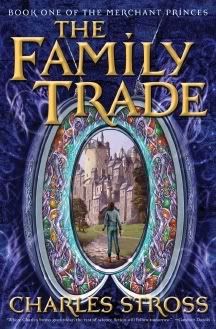
Acquired Tastes: Merchant Princes Series by Charles Stross


If you like:

a fully realized, yet fat-free incursion into alternative history;

gripping, yet accessibly immersive accounts of power struggles within a Mafia-like ruling family;

feisty, intelligent female characters who do not traipse around in their underwear,

then you would probably enjoy the work that Charles Stross has produced for his Merchant Princes series.

It's not your usual science fiction/fantasy hybrid, and I never thought that I would have so much fun seeing basic economic theory used so well in such slim volumes. My compliments to Fully Booked for including this wonderful series in their catalog, though I must warn you that there are several editions on sale, and one edition is significantly more expensive than the other.

Photo Credits:

Picture of The Family Trade comes courtesy of Amazon.

Monday, June 30, 2008

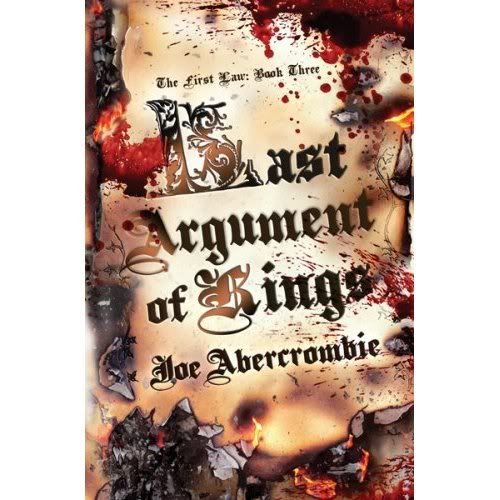
Acquired Tastes: The Last Argument of Kings

My, my. Joe Abercrombie has done it again. Just when I thought that my post-summer reading list could not have been more enjoyable, once again, my patience with one of my favorite genres has paid off. The concluding book of The First Law trilogy could not have been more exhilaratingly, subversively, compulsively delightful. A tired old genre, populated either by the doddering remnants of formerly great writers, or sadly bereft of truly inspired creators, is suddenly fresh again. Last year, I wrote on this blog:

Pick it up. The darkly comic was never this...comic. Imagine Ricky Gervais doing Lord of the Rings and you just might have Before They Are Hanged.

But, to Abercrombie's credit, instead of coasting on his ability to craft absurdly funny situations dripping with dark wit (a rare enough talent as it is), he chose to pierce the veil of the wickedly funny to reveal the sad, interminable cost of war at the very heart of it. It is the fitful, beating heart of the survivor that raises this precious little trilogy from the entertaining diversion it was into the intelligent, and bravely humorous meditation on the men and women ruined by heroism that it grows up to be.


Photo Credits:

Picture of The Last Argument of Kings comes courtesy of Amazon UK.

Monday, June 16, 2008

Waiting to be Read: Books on Queue

People oftentimes ask me for book recommendations, but I've never felt comfortable about setting myself up as some sort of authority on books. Other than my keen intelligence, exceptional taste, and exemplary humility, I am sadly ill-equipped to tell people what to read. Rather, I'm more interested in what other people have to say about what they have been reading.

In order to coax more people to share which books have made their reading much more pleasant lately, let me share a short list of books that I haven't read, but probably will, if only to justify the frequent bouts of impulse shopping that I am afflicted with every single time that I pass by Fully Booked in Bonifacio High Street.

1. The Yiddish Policeman's Union.
2. The Dragon Waiting.
3. Lud-in-the-Mist.

What's on queue with you?

Cover of The Dragon Waiting comes courtesy of Fantastic Fiction.

Monday, June 02, 2008

Science Fantasy and Other Delightful Surprises

Sometimes, the best things in life just happen, with very little conscious thought, but with a great deal of deliberate grace. I was passing by National Bookstore in EDSA Shangri-La Mall when I came across the books which comprise the Chronicles of Chaos trilogy. And yes, you read it right. It's a trilogy. In this day and age, where second-rate writers churn out as many books as possible to keep themselves in hog heaven, John C. Wright wrote a trilogy. With all due respect to the late Robert Jordan, his success in the high fantasy genre encouraged every second-rate, derivative, pretentious hack to produce some spectacularly awful books in the hopes of replicating Jordan's epic Wheel of Time series. This is why a trilogy is so welcome. Like R. Scott Bakker, another wonderful fellow who penned a thought-provoking epic trilogy The Prince of Nothing, Wright's science fantasy epic has a beginning, a middle, and an ending, which is more than can be said of the many series being published today.

And yes, it is science fantasy. The problem with hard science fiction is that it tries to convey wonder through definition. Science fantasy, on the other hand, conveys wonder through definitions that require an a priori response that questions the rigidity of such definitions. In other words, this genre requires an enormous leap of faith that validates belief in magic of a sort.

Reviewer Paul Di Filippo writes:

Science fantasy is a blend that requires enormous skill to bring off. The author must mix the improbable with the probable, the fanciful with the hard-nosed, the rational with the supernatural. Luckily, John Wright is just the man for the job...he effortlessly blends the two.

Astute readers will detect flavors here of Philip K. Dick (the games with the nature of reality); A.E. van Vogt (the recomplicated shifting alliances); Roger Zelazny (the mythology mixed with contemporary slang); James Branch Cabell (the droll speech patterns of Boreas, the school's headmaster); Clark Ashton Smith (the descriptions of otherworldly realms); A.A. Attanasio (the gnostic interplay between gods and humans); C.S. Lewis (the Narnia-style trope of teens with noble secret identities); and so forth and so forth, with more allusions that I've probably even overlooked.

This kind of homage-laden, deep-lineage fiction can get over-intellectual and stultifying in the wrong hands. But Wright keeps it fresh and sprightly, mainly thanks to never losing sight of the teenage high spirits of his protagonists, especially his perfect narrator, Amelia.


Pick it up. After all, who can resist an author who, after having converted to Catholicism, insists that "If Vulcans had a church, they'd be Catholics." It's refreshing to read the works of a man who knows exactly, in the wonderfully chaotic way that science fantasy makes the impossible possible, where he's heading, be it in fiction or in life. Enjoy!

Friday, February 29, 2008

Stupid Bok?


Given my last entry, it should have been easy to summarily pass judgment on Augusto Syjuco's free textbook "Mag Tek-bok Ka Bok". After all, noted educator and crusader Antonio Calipjo Go, to quote from his entry in Iloilo Views condemned Syjuco's book as "completely dedicated to the practice of narcissism and toadyism", a distasteful and dishonest book that "wastes your time" as well as "dirties and defiles your soul".

Strong words indeed. In the interests of determining the truth, an activity of the soul very much in fashion nowadays, why not decide for yourself? Click here.

Photo Credits:
Picture comes courtesy of e-Tesda Portal.

Crimes Against Humanity: Stupid Books


Every once in a while, I come across an article, or an idea for an article, that I wish that I had thought of first. Just as infrequently, I sometimes come across an article that reflects a refreshing amount of candor or courage that I would normally take a pass on. At any rate, the following article (which was first printed in Luke McKinney's blog, then reprinted in Cracked, is one of those rarities: an article that I wish I had thought of first, but would probably not have written in the way that it eventually turned out.

The premise?

The printing press has been hailed as the most important invention in history, allowing smarter people to share their ideas with other less smart people. Unfortunately one of the ideas they shared was "printing presses" and since then the device has been abused to wreak such horrors as to make nuclear power look like an innocent and harmless kitten-based technology. In this series I'll be looking at books so hideously opposed to the idea of knowledge that every time one is sold, a scientist loses his lab coat.


The book?

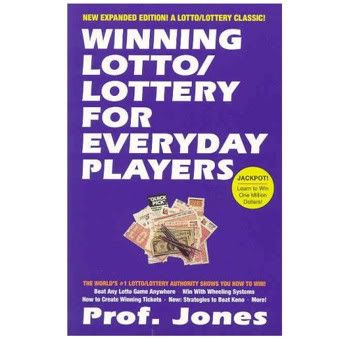
"Winning Lotto/Lottery for Everyday players, 3rd edition" by Professor Jones

The scathing commentary? (And yes, this is the fun, not for kids under the age of 13 part.)

The use of "everyday players" conjures the absurd vision that lives in the minds of the target market, that they are mere regular players while a secret cabal of professionals keep scooping all the jackpots. Why, if only they had access to some kind of inside knowledge they could make it too!


and

3rd. Goddamn. Edition. I have no idea what possible refinements to lotto-winning technology the author could be adding each time, short of scribbling "hahaha, oh god this is working I can't believe it's working" all over the proof copy before sending it back to the printers. A third edition of anything hasn't damaged my faith in humanity so much since the Daily Mail ran their "Princess Diana - still dead" memorial in 2000.


and

If you can get past the title, the back-cover blurb is an even richer treasure trove of anti-logic weaponry designed purely to annoy anybody capable of thought, though we may be able to use them to confuse the machines once they take over. Professor Jones proudly claims to have designed dozens of lotto-predicting programs, another sanity-shattering "the very fact I can make twenty proves they're all crap" claim, before promising to reveal the secrets of interpreting your dreams for winning lotto numbers. I hate to break it to you but if the best your conscious mind can come up with is "buy a book about how to win the lotto written by someone who has not done so", then your unconscious is unlikely to be some unharnessed money making probability superpredictor.


The odd moment of clarity and insight?

This book is simply cruel. Buying a lotto ticket may be a tax on people who don't understand statistics, but it still provides that momentary hope, the few seconds of dreaming and a pleasant image. This book specifically harnesses and murders those hopes, telling the reader that playing the lotto is actually a valid financial strategy and something that can be worked at rather than the moments harmless escapism it is. When you're taking the money while killing the dreams of those left with nothing to hope for but winning the lottery, you have officially reached the rank of King Bastard.


Photo Credits:

Picture of Winning Lotto/Lottery for Everyday players, 3rd edition" by Professor Jones comes courtesy of Amazon.

Thursday, November 08, 2007

Adaptations: Books and Movies


Our good friends at the A.V. Club have come up with a couple of lists that invite reaction. The first article lists down twenty good books that have been turned into, for the lack of a better word, crappy movies. The second article, perhaps in a concession to the exploring the spiritual dimension that sustains all entertaining movies, particularly the qualities of hope and grace, feature twenty one books that should be turned into movies. All in all, an excellent pair of articles that should provide much needed fodder for those otherwise lonely trips to the watercooler.

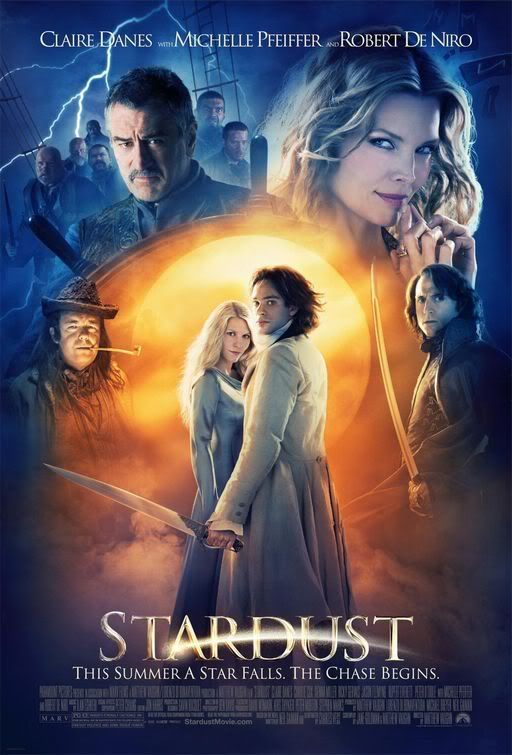
When I was younger, I really enjoyed Breakfast at Tiffany's, but while the ethereal Audrey Hepburn remains a timeless, incandescent angel, I cringe every time I hear Mickey Rooney's embarrassing Japanese caricature. I haven't caught Stardust yet, but if the best thing about the movie is that ham Robert De Niro's performance, then that's just sad. I have fond memories of what is, to my mind, Gaiman's sweetest prose work.

Photo Credits:

Stardust poster comes courtesy of Internet Movie Posters Awards Gallery.

Thursday, September 20, 2007

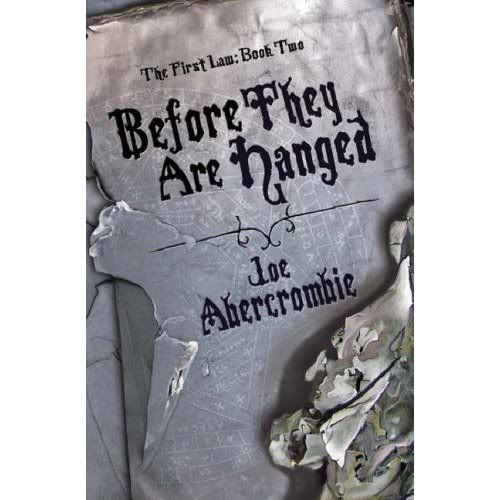
Acquired Tastes: Before They Are Hanged


It seems that the good Lord would have me learn some patience. Otherwise, why would He have made the air traffic at London Heathrow so interminably bad that it delayed our departure by a full hour? As a result, I find myself waiting for Cathay Pacific's 10 pm flight to Manila, instead of the earlier 4:30 pm flight that I so wanted to catch. By the time I get home, my boys will be asleep. Grr!

Yet, not all is lost. Whilst I was in Merrie Old England (and I ask my English friends for my gruesome attempt at approximating British banter, but barely bearable alliterations always have been a weakness of mine), I read the second book of Joe Abercrombie's The First Law series, Before They Are Hanged. As I wrote earlier, Abercrombie, in his inimitably British way, what with the deliciously dark, subversive bent he brings to a brand of humorous epic fantasy that seems to have interred itself with the decomposing wit of David Eddings, is a marvelous read. Here's the synopsis that the publishers provided at the back cover:

"We should forgive our enemies, but not before they are hanged." Heinrich Heine

Superior Glokta has a problem. How do you defend a city surrounded by enemies and riddled with traitors, when your allies can by no means be trusted, and your predecessor vanished without a trace? It's enough to make a torturer want to run – if he could even walk without a stick.

Northmen have spilled over the border of Angland and are spreading fire and death across the frozen country. Crown Prince Ladisla is poised to drive them back and win undying glory. There is only one problem – he commands the worst-armed, worst-trained, worst-led army in the world.

And Bayaz, the First of the Magi, is leading a party of bold adventurers on a perilous mission through the ruins of the past. The most hated woman in the South, the most feared man in the North, and the most selfish boy in the Union make a strange alliance, but a deadly one. They might even stand a chance of saving mankind from the Eaters. If they didn't hate each other quite so much.

Ancient secrets will be uncovered. Bloody battles will be won and lost. Bitter enemies will be forgiven – but not before they are hanged.

Pick it up. The darkly comic was never this...comic. Imagine Ricky Gervais doing Lord of the Rings and you just might have Before They Are Hanged.

Photo Credits:
Picture of Before They are Hanged comes courtesy of Amazon U.K..

Sunday, September 02, 2007

Acquired Tastes: New Fantasy Novelists


Longtime readers of epic fantasy like myself, in lieu of waiting with bated breath for the latest opus from either Robert Jordan (whose last effort, Knife of Dreams, was magnificent) or George Martin (whose last effort, A Feast for Crows, was dismal), have taken to exploring relatively new fantasy authors, and with good reason. Newcomers such as Steph Swainston and Joe Abercrombie, if their initial works are a valid indicator of their storytelling gifts, have much to impart to a whole new generation of fantasy readers, at least insofar as characterization and sheer cheekiness is concerned.

Swainston seems further along, at least in terms of artfully distilling both sure-handed characterization and delightfully surreal plotting, though her graphic depiction of the horrors of addiction (in the person of Jant, the winged immortal narrator of her critically acclaimed The Year of Our War) demands a mature sensibility that prevents me from wholeheartedly recommending it to younger readers, as I'm not entirely certain if I'm mature enough to be reading it.

But Abercrombie's book, for all of its pretensions towards generating sympathy for its supposedly blatantly characterized anti-heroes, is really all about heroes. All his principal, supposedly "grim" and "morally compromised" heroes may dally with the darker aspects of the human experience from time to time, but they never seem to seriously want to live the life of the morally bankrupt. Plus, they're great fun and wonderful wits, not in the almost unbearable way that the characters of David Eddings can sometimes be (seriously, how can almost everyone in the Belgariad possess the same gently subversive humor and adopt the same patterns of slyly affectionate wit?). Despite the blurb on the back cover, and the stubborn insistence of its main characters, this book is a celebration of heroism, in spite of it all.


Photo Credits:
Image of The Blade Itself comes courtesy of Amazon.

Tuesday, July 24, 2007

Anger be now your song, immortal one...


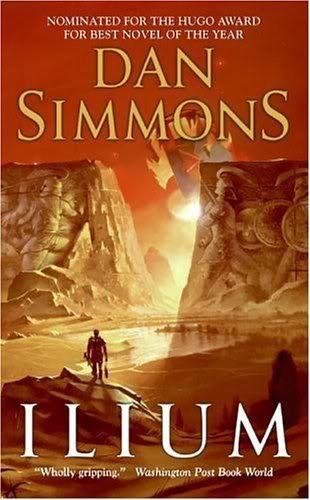
Happily, despite my oftentimes interminably busy schedule, I've found time to do quite a lot of leisure reading. In lieu of my usual rambling posts on Life, the Universe, and Everything (with all due respect to one of my childhood favorites, Douglas Adams), let me recommend a wonderfully re-imagined classic, the Iliad, by way of Dan Simmons' almost unclassifiable duology, Ilium and Olympos.

Heavily intertextual, with consistently appropriate references to Homer, Shakespeare, and Proust (among other literary giants), the Trojan War comes alive through the skillful exploration of a technological singularity that allows quantum theory, and nanotechnology to bring to life a gripping, and action-filled drama between men and gods.

What if Achilles didn't kill Hector? What if the Achaeans and Trojans set aside their differences and, instead, take charge of their destinies? What if, instead of warring with one another, they declare war on the gods?

Pantheistic solipsism has never been more fun, or as cool. Even if you have no idea, or intention, to get into the science behind the fiction, this duology is a fantastic read. Try it.

Photo Credits:

Picture of Ilium comes courtesy of Amazon.

Wednesday, April 25, 2007

Encomium: Kurt Vonnegut and David Halberstam


I have always associated the summer months with reading. When I was younger, I always looked forward to summer vacation not particularly because of the many trips that my family would take, either to the beach or to colder climes, but because of the opportunity to meet up with old friends and perhaps meeting some new ones; summer was when I would read. In the same way that extended trips outside the metropolis seemed to provide my parents a much needed respite from their work, burrowing inside a good book seemed to put everything in perspective for me: that this almost intolerable heat, this unbearably long car ride, is a necessary cross to bear on the way to a much nicer place to read in.

This summer has not been kind to writers. First, I said farewell to an old friend, Kurt Vonnegut, whose passing was marked by a wonderfully poignant entry from Jessica Zafra where, in her grief, she wisely lets his work speak for himself, a gently elegant compromise that was carried further by The A.V. Club when they listed down the "15 Things Kurt Vonnegut Said Better Than Anyone Else Ever Has Or Will".


More recently, journalists of all stripes have been mourning the death of Pulitzer-prize winning reporter David Halberstam, who met an untimely end on April 23, 2007 in California. Such was his passion for life that he employed the same unbridled fire and discipline with which he penned his more "serious" works (such as his unyielding coverage of the Vietnam war) towards his supposedly "lighter" but disarmingly profound meditations on sports. A good introduction to Halberstam and his profound influence on American culture in general would be Clyde Haberman's moving obituary piece in The New York Times and the more sentimental, but well-documented encomium penned by Henry Abbott of TrueHoop.

Rest in peace, my friends. Thanks for all the summers.

Photo Credits:

Picture of David Halberstam comes courtesy of Wikipedia.

Picture of Kurt Vonnegut comes courtesy of Reno and its Discontents.

Wednesday, March 28, 2007

Acquired Tastes: Neil Gaiman's Neverwhere


My mother-in-law has an absolute passion for literature and learning, which is why I wasn't even mildly surprised when I spied, next to her copy of Elie Wiesel's Messengers of God, the graphic adaptation of Neil Gaiman's Neverwhere, a distinct combination of eclectic intelligentsia that merely confirms that Mama Dodie is a nerd of the highest order. Still, I borrowed her copy of Mike Carey's adaptation of Neil Gaiman's first full length novel with trepidation. Given my critical misgivings (and wholehearted, gleeful appreciation) of the cinematic adaptation of Frank Miller's 300, I understood all too clearly the dangers of adaptation.

Fortunately, we're in good hands with Mike Carey. In his introduction to Neil Gaiman's Neverwhere (a clunky title which is probably a source of profound embarrassment to Mr. Gaiman), Carey writes:

I was asked in an interview recently what I thought of the Constantine movie, and I said that it was very enjoyable as long as you didn't go into it expecting "the film of the book." What that glib comment conceals is the extent--the enormous extent--to which any adaptation splits itself off from its source and becomes its own journey: its own answer to a set of questions that only formulate themselves as you set to work. Peter Jackson's Lord of the Rings, Ridley Scott's Bladerunner, Brecht and Weil's Threepenny Opera, the stage versions of The Producers and His Dark Materials, they're all straight jazz riffs on their wonderful originals rather than straight translations. Because straight translation from one medium to another is both impossible and undesirable.

It is this understanding of the problems involved in adaptation, as well as the gorgeous art by Glenn Fabry, that probably accounts for my enjoyment of Neil Gaiman's Neverwhere. I heartily recommend it, even if you aren't slogging through less than triumphant adaptations of scholastic thought that my students have been submitting lately. It's one way to get through the painstaking task of walking the fine line between constructive criticism and the utter annihilation that shoddy academic work deserves.

Oh well. One has to be several kinds of madman to even want to teach, really. To borrow liberally from Mr. Gaiman's insight into the character of Emperor Joshua Norton in "Three Septembers and a January", my madness keeps me sane.

Picture of Neverwhere comes courtesy of Amazon.

Monday, March 26, 2007

Acquired Tastes: Tolkien and Herbert


Just as soon as I was ready to return to the daunting pile of papers which currently constitute my very own Annapurna, I stumbled across the startling news that the The Children of Húrin, the posthumous Lord of the Rings novel that Christopher Tolkien spent close to three decades preparing for publication will be released worldwide on April 17, 2007. Appropriately enough, breaking news of this sort got an enthusiastic response from geek haven Fark, where in true geek fashion the responses were largely negative, if only because Tolkien has always been a sort of a rite of passage for all would-be geeks. While it would be interesting to offer a digression on the schismatic qualities of Tolkien's work, that's a post for another day. Instead, here's a sample of the comments that the aforementioned news spawned:


Nerdlinger

I will never claim LOTR is great literature, but seriously, if you are in a bookstore you should pick up the Silmarillion and read a page or two. You will be willing to nominate LOTR for the Nobel Prize after you stop throwing up.

Faethe

You have to be into way sappy stuff. It's cheese. English cheese. Stiltson. Good on everything, but way stinky.

Tolkien is like that.


Oddly enough, the writer who get the raw end of the deal for this particular post was Frank Herbert's son, Brian. To wit:


Paulson

I hope he doesn't follow in the footsteps of Frank Herbert's son. The stuff he pissed out is an abomination to the Dune series and literature in general.

CowboyNinjaD

The new Dune books are pretty good if you ignore the weak writing, unlikely motivations of characters and at least a half-dozen things that contradict the first 100 pages of the original book.

But other than that, they're awesome.

Bring on the whored-out version of LOTR.

theexistent

Brian Herbert could be forgiven his sin of being a piss-poor writer (along with Kevin J. Anderson) if he at least evidenced an understanding of his father's Dune novels. Given that in his first prequel he conflicts with canon in the SECOND FREAKING SENTENCE it was pretty apparent he had no intention of remaining faithful to his father's vision. It also showed up that his lame excuse of writing sequels (he found his father's notes) was absolute BS. I hope there is an afterlife just so his father can give him an epic azz whooping for running such a beautiful universe into the sand.


Picture of The Children of Húrin comes courtesy of Amazon.

Wednesday, January 31, 2007

On the Necessity of Moriarty


Over time, I've accumulated a lot of old magazines, generally for the express purpose of having something interesting to read during my daily escapist fantasies where I indulge a hidden, but very real desire to aspire to royalty, at least in terms of functional furniture whose primary purpose is to support the regio glutealis. Anyway, I came across this interesting article in the August 11, 1997 issue of the New Yorker, where Alex Ross critiqued the book of Ben Macintyre, The Napoleon of Crime: The Life and Times of Adam Worth, Master Thief. According to Ross, Macintyre (a distinguished British journalist who writes for the Times) claims in his book "that there really was a Professor Moriarty: a Victorian criminal on whom Conan Doyle's evil genius was based". Since I read historical fiction, or pseudo-historical fiction on a more or less regular basis, I was amused to hear of Worth. What caught my attention though was the rather curious relationship between the supposed archcriminal, Worth, and his nemesis, the famed William Pinkerton. Ross writes:


"In a chapter entitled 'Moriarty Confesses to Holmes,' Macintyre wrings romance from the friendship between the aging Pinkerton and the fallen Worth. But the episode also points to a pathetic crisis in Pinkerton's mind, of which Worth took material advantage. The detective, at this stage in his career, was known less as a wrangler of outlaws than as a brutal strikebreaker: the suppression of the Homestead strike of 1892 was his handiwork. Now he set about rescuing and immortalizing a worthier, more mythic foe, his own private Moriarty."


The rest of the article details how Pinkerton not only stage-managed Worth's so-called redemption (by returning a priceless painting to its rightful owners), but actively set out to cement Worth's reputation as "the most inventive and daring criminal of modern times" by producing a pamphlet published by the Pinkerton Agency offering glittering testimonials to Worth's supposed genius.


I suppose that this necessity, on Pinkerton's part, to create an archcriminal to validate his own legacy as a detective, could be viewed as some sort of cautionary tale regarding man's need for validation. But for me, the necessity, so to speak of Moriartys, is indicative of man's quest for meaning: there has to be some sort of fundamental operating principle, or fundamental organizing structure that allows us to make sense of everything. This is similar to how the late Canadian theorist Northrop Frye considered myths: as recurring themes, images or archetypes that allow us to delve into the supposed structure that links all stories together, and by extension, all of humanity.


One thing's for sure though: you must be incredibly lonely to invent myths just to make you feel better about yourself. That, more than anything, struck me the most.

Photo Credits:
Picture of The Napoleon of Crime: The Life and Times of Adam Worth, Master Thief comes courtesy of Abe Books.