Showing posts with label Shakespeare. Show all posts

Thursday, June 04, 2009

Nerditry! Hamlet and the Christian Perspective


I just read that there will be a new Hamlet movie featuring Emile Hirsch and Twilight director Catherine Hardwicke.

Interestingly enough, in an informal chat with Paul Dumol yesterday, my friends and I discussed Shakespeare's play in terms of its timeless wisdom and unabashedly Christian roots. While most people would not have considered Hamlet a particularly Christian literary work, through patient reading and careful synthesis, we determined that Hamlet may be considered as such for the following reasons:

In Act 1, scene 5, the Ghost declares, almost surreptitiously given the censors of the time, that he had come from Purgatory.

I am thy father's spirit,
Doom'd for a certain term to walk the night,
And for the day confined to fast in fires,
Till the foul crimes done in my days of nature
Are burnt and purged away.


There is the constant reference to the sacraments, as may be read in the same scene with the Ghost:

Cut off even the blossoms of my sin,
Unhousel’d, disappointed, unanel’d,
No reckoning made, but sent to my account
With all my imperfections on my head.
O horrible! O horrible! most horrible!


As Marty Barrack wrote in his article on Hamlet, ”Reckoning” is an archaic term for the Sacrament of Confession, “anel’d” for the Sacrament of Anointing of the Sick and Dying, and “housel’d” for the Sacrament of Holy Eucharist.

Furthermore, we have Claudius' penitential prayer in the 2nd scene, where Hamlet withholds taking his uncle's life in order to effect a more encompassing revenge:

O, this is hire and salary, not revenge.
He took my father grossly, full of bread;
With all his crimes broad blown, as flush as May;
And how his audit stands who knows save heaven?
But in our circumstance and course of thought,
'Tis heavy with him: and am I then revenged,
To take him in the purging of his soul,
When he is fit and season'd for his passage?
No!


Finally, there is the overt reference to the Gospel according to St. Matthew (Chapter 10, verses 28 onwards) in act 5:

"...there's a special
providence in the fall of a sparrow. If it be now,
'tis not to come; if it be not to come, it will be
now; if it be not now, yet it will come..."

While the above reasons are far from complete, the fact that a bunch of fairly literate, dashingly attractive people such as my friends and I chose to spend a great deal of the little time we have to hang out with one another on Hamlet tells me that perhaps a new Hamlet movie is not just inevitable, but appropriate. We just have to prepare ourselves to discuss, with intelligence, humor and grace, yet another interpretation of a classic work of literature.

After all, as the Bard wrote, "the readiness is all". Enjoy!

Advanced nerds may want to check out a snippet of "Try what repentance can": Hamlet, confession, and the extraction of interiority by Paul D. Stegner. Peter Goldman wrote a review of Stephen Greenblatt's Hamlet in Purgatory entitled Hamlet's Ghost: A Review Article, which contains several points of interest regarding the Ghost and the Christian traditions that permeate Hamlet.

Thursday, May 07, 2009

"Sonnet-ry!"


As many of you know, one of the delightful little rituals I love greeting the day with is reading a sonnet to my little princess, Lucia. I love seeing the twinkle in her eye when I rouse myself from my slumber and exclaim "Sonnet-ry!"

Today, we read Sonnet LXXVI, which I am reproducing in its entirety below:

Why is my verse so barren of new pride,
So far from variation or quick change?
Why with the time do I not glance aside
To new-found methods and to compounds strange?
Why write I still all one, ever the same,
And keep invention in a noted weed,
That every word doth almost tell my name,
Showing their birth and where they did proceed?
O, know, sweet love, I always write of you,
And you and love are still my argument;
So all my best is dressing old words new,
Spending again what is already spent:
For as the sun is daily new and old,
So is my love still telling what is told.

As is common to any sincere, if not entirely rational, attempt to understand the sonnet, there are many interpretations. However, I choose to read it as a celebration of constancy, which reaches its fulfillment in the sonnet Tina and I chose to celebrate our union with:

Let me not to the marriage of true minds
Admit impediments. Love is not love
Which alters when it alteration finds,
Or bends with the remover to remove:
O no! it is an ever-fixed mark
That looks on tempests and is never shaken;
It is the star to every wandering bark,
Whose worth's unknown, although his height be taken.
Love's not Time's fool, though rosy lips and cheeks
Within his bending sickle's compass come:
Love alters not with his brief hours and weeks,
But bears it out even to the edge of doom.
If this be error and upon me proved,
I never writ, nor no man ever loved.

Thus, I look forward to tomorrow, where once again, Lucia and I can enjoy our "Sonnet-ry!"

Monday, March 09, 2009

Acquired Tastes: Marbury as Othello


Every morning, before I head off to work, I read my daughter Lucia one of Shakespeare's sonnets. While some might accuse me of intentionally setting my little princess up to be an intellectual snob of frightening proportions, let me assure one and all that it's true: I am intentionally steeping my lovely Lucia into some of the finest verses ever minted in the English language. While she might never develop a taste for Shakespearean literature in particular, it is my fondest hope that she will always find herself drawn to good literature in general.

We just finished Sonnet 28. Fantastic stuff!

Equally good is The Onion's article on Stephon Marbury. Like most attempts to use the Bard in a contemporary comedic situation, there's little that can be excerpted as one-liners, but much can be mined from a thorough reading of the entire piece.

Enjoy!

Photo Credits:

Picture of Stephon Marbury as Othello comes courtesy of The Onion.

Tuesday, March 20, 2007

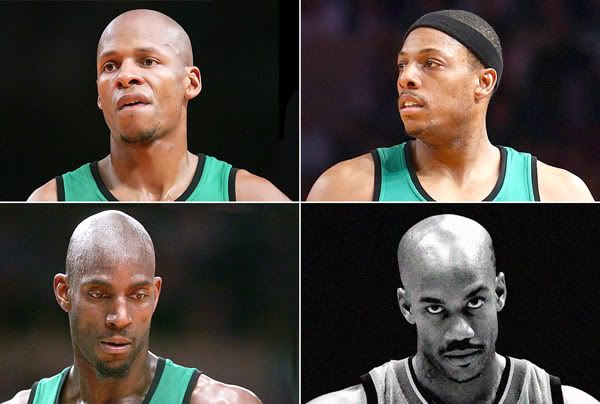
Shakespeare and Basketball


I wasn't going to post any entries since it's the end of the semester and I have quite a lot of checking to do, but I couldn't resist. I got to this wonderfully written blog entry via Henry Abbott's new True Hoop site on ESPN. While Henry's migration to the self-proclaimed Worldwide Leader in Sports is news in itself, I decided to save the inevitable vitriol involved and instead credit True Hoop (and, by association, the Worldwide Leader) for leading me to Celtic Shakespeare. Here are some excerpts worth considering:

On the raison d'etre for the post:

I have seldom been accused of being overly cultured. I have stains on all my best shirts, eat with little to no regard for table manners, and I'm "that guy" that makes out of place comments at parties that stop conversations dead in their tracks.

However, I do hold on to at least one sophisticated acquired taste. I love Shakespeare. I've seen dozens of plays and read more than half of the Bard's works.

A lot of people simply can't stand the language and/or don't appreciate the poetry weaved into his prose. This will largely be lost on those people, but oh well. To everyone else, I hope you enjoy and feel free to chime in with your own in the comments.

On hope in Boston:

Now is the winter of our discontent, made glorious summer by this sun of York - Richard III

It has been a long, hard winter of discontent for the Celtics, but there is hope for a glorious summer. We need a lot of luck and a lot of hard work by the management team. But there is hope ahead.

"Out, damned spot! out, I say!" --Lady Macbeth

To Vin Baker’s cap hit. The blight of Vin Baker will finally pass into the history books. We bought out his contract long ago, but the cap hit was spread across several years to lessen the blow. As of this summer, he’s no longer on the books!


On the talented, but sometimes overenthusiastic Bill Simmons:

Therefore, since brevity is the soul of wit, and tediousness the limbs and outward flourishes, I will be brief. – Polonius (in Hamlet)

To Bill Simmons. If you read the context of this quote you’ll see the irony of it. Polonius is like Simmons in that he believes nothing is worth saying unless you can stretch it out to 20,000 words. I love Bill, but sometimes the best writing comes in small packages.


Picture of William Shakespeare comes courtesy of The Classic Literature Library Presents William Shakespeare.

Picture of Bill Simmons comes courtesy of Charlie Powell, in Slate.