“We shall not cease from exploration
And the end of all our exploring
Will be to arrive where we started
And know the place for the first time.”
TS Eliot
Dan Brown, one of the most accomplished storytellers of the 21st century, is also the author of some of the most poorly constructed opening sentences in publishing history. To wit:
Renowned curator Jacques Saunière staggered through the vaulted archway of the museum's Grand Gallery.
Physicist Leonardo Vetra smelled burning flesh, and he knew it was his own.
Death, in this forsaken place, could come in countless forms. Geologist Charles Brophy had endured the savage splendor of this terrain for years, and yet nothing could prepare him for a fate as barbarous and unnatural as the one about to befall him.
As linguist Geoffrey K. Pullum noted before in his highly informative and snarkily entertaining post , "The simple fact is that if you are ever mentioned on page 1 of a Dan Brown novel you will be mentioned with an anarthrous occupational nominal premodifier ('Renowned linguist Geoff Pullum staggered across the savage splendor of the forsaken Santa Cruz campus, struggling to remove the knife plunged unnaturally into his back by a barbarous millionaire novelist'), and you will have died a painful and horrible death by page 2, along with several curiously ill-chosen clichés and mangled idioms."
In literature, one can judge the worthiness of novels by the artistry and economy of their opening sentences. Who can forget, for example, the profound simplicity with which Gabriel Garcia Marquez begins Love in the Time of Cholera? "It was inevitable: the scent of bitter almonds always reminded him of the fate of unrequited love."
But what is true of literature is not quite true when one considers public perception: truly, he who laughs last, laughs last. And it is with the full, bitter regret of scented almonds that I lament the painful and horrible beating that the Filipino people has taken due to the brutal inhumanity of the perpetrators of the massacre in Maguindanao.
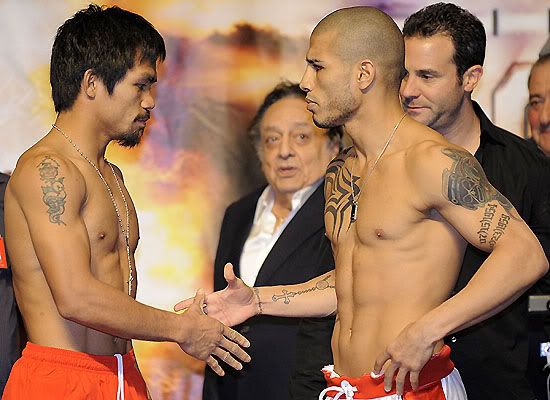
The sublime artistry with which Manny Pacquiao dispatched Miguel Cotto? Forgotten.
The overwhelming generosity of spirit with which Efren Penaflorida shares the best of himself and by extension, the Filipino people, with the urban poor? It's almost as if Penaflorida's courageous selflessness never happened.
Instead, we are left with the grim reminder that man is a killer angel, whose sometime, lamentable descent into barbarism stems from a fatal misunderstanding of Hamlet's observation:
What a piece of work is a man, how noble in reason, how
infinite in faculties, in form and moving how express and
admirable, in action how like an angel, in apprehension how like
a god!
It is only when we act as if we are gods that we cease to be human.
We lament what happened in Maguindanao. But let us remember what also happens whenever we recall that our lot in life is not simply to be the authors of tragedies. Mother Theresa once said, "Do not think that love, in order to be genuine, has to be extraordinary. What we need is to love without getting tired." This guy does not tire. Neither should we. Hope floats. And with hope, truth.
Last Sunday, I didn't just watch a boxing match. I witnessed a transformation. Two brutally skilled boxers, by virtue of their sublime dedication to professional brutality, became champions.
What does it mean to be a champion? Does it mean, simply, to win? Perhaps. And yet, even a slight perusal of recorded sporting history would yield the following observation: many of the champions whose greatness has stood the test of time did not possess sporting records untarnished by defeat. But they all possessed sporting records where their defeats were untarnished by surrender.
Boxing pundit Saad Farooqi wrote very movingly about what characterized the finest boxing champions that the modern world has been privileged to witness:
When one says Ali is the greatest fighter (regardless of whether one agrees or not) of all time we aren’t thinking of young Cassius Clay hammering Liston into submission. We aren’t thinking of the dance master blitzing his opponents from countless angles and directions. To tell the truth, we think Ali/Frazier or Ali/Foreman. We think of a heavier, slower aging boxer his skills no longer glossed with youth and speed. The Ali we call "The Greatest" is the boxer who stepped in the ring against an opponent no one gave him a chance to win and then winning it. That was what made him the greatest: courage. It was him proving to boxing pundits that you can never measure human spirit or guess what it is capable of...
And that’s what boxing is all about: courage and character. Miguel Cotto and Manny Pacquiao showed that throughout their fight. It’s not skill or power or technique that defines a boxer as much as it does his courage to do what most men and women won’t even dream about.
It is easier to understand this from the perspective of the valiant Cotto. He had every reason in the world to give up. He didn't. That took courage.
It is harder to understand this from the perspective of the victor. Manny Pacquiao won, and in a very convincing fashion. But that's not why he is, ultimately, a winner. Anyone can win due to an overwhelming display of talent, skill, and passion. But very few people win with a grace that ennobles both the victor and the vanquished. After the fight, Manny refused to crow about his victory.
“I always tell myself that I am just an ordinary fighter, but I have to beat the best fighters and sometimes I can,” he said.
Sometimes, those who believe that they are just ordinary people who, by virtue of their skill, passion and determination end up with the wonderful opportunity to compete at the highest level, end up as winners. But always, they end up as champions.
Photo Credits:
Picture of Manny Pacquiao and Miguel Cotto comes courtesy of GMA News.
By now, I suppose everyone has seen the video of Manny Pacquiao serenading a worldwide audience with his interpretation of Sing-Along-Kot staple, Sometimes When we Touch. Just in case you haven't, please click on the embedded video below.
Many Filipinos of my acquaintance are quick to voice their reactions to Manny's performance on Jimmy Kimmel Live. Most negative reactions range from "Don't give up your day job" to "He's an embarrassment to the Filipino people." It is to those who belong in the latter extreme that I address this blog entry.
Conrado de Quiros once observed that "I’ve seen athletes turn from ferocious to meek when interviewed after stunning victories, finding the task of organizing their thoughts or expressing themselves in another language far more daunting than the challenge they had just faced. Pacquiao was not one of them. He was as fearless facing his interviewer as he was facing Ricky Hatton."
Manny's boundless confidence in himself led de Quiros to postulate that perhaps it is this hard earned self-assurance, this certainty in both his talent and his self-worth, that is Manny Pacquiao's biggest strength. To jaded eyes, it seems that majority of social structures in the Philippines are designed to reinforce a sense of inferiority, or at the very least, a limited and limiting understanding of "one's place" in life. Manny, like most world-class Filipino talents, refuses to see himself in those terms. As, de Quiros once again pointed out, "Though his answers were humble, his demeanor was not. He was unfazed by the crowd, he was unfazed by the cameras, he was unfazed by his English. They were merely of the order of facing another foe, not unlike the one in the ring, and vanquishing them."
Perhaps we should be less concerned about Manny's perceived inability to do justice to a sentimental old love song. Instead, maybe we should consider that we have the privilege of witnessing a world-class Filipino talent, by proving that he can fail at something, rectify an injustice deeper and more insidious than annihilating the opus penned by Dan Hill: that our understanding of ourselves as a people, and our supposed self-worth, is determined by how others perceive us.
Once again, Manny has done us proud. Even in supposed failure, he remains, unreservedly, Manny Pacquiao. Sometimes, we should be touched.
While the recently concluded holidays may sometimes be a source of stress for some families, happily, this was not the case with mine. My boys and I went trick or treating next door at their preschool, and a gauntlet of sorts was passed when Lucia arrived in Manuel's old pumpkin costume, which was originally worn by their elder cousin Miguel. Pictures may be seen here.
Manuel, on the other hand, may be seen below. If there ever was a picture that fully captured how a pagan rite of passage has metamorphosed, thankfully, through the years into an innocuous and joyful celebration of youthful exuberance, it would be this picture. Janis Joplin might have sung "Freedom is just another word for nothing left to lose," but in Manuel's case, freedom is just another word for candy around the corner. The boy has a sweet tooth that puts his father's to shame, and I fear that this year's Halloween celebration finally set that monster free.
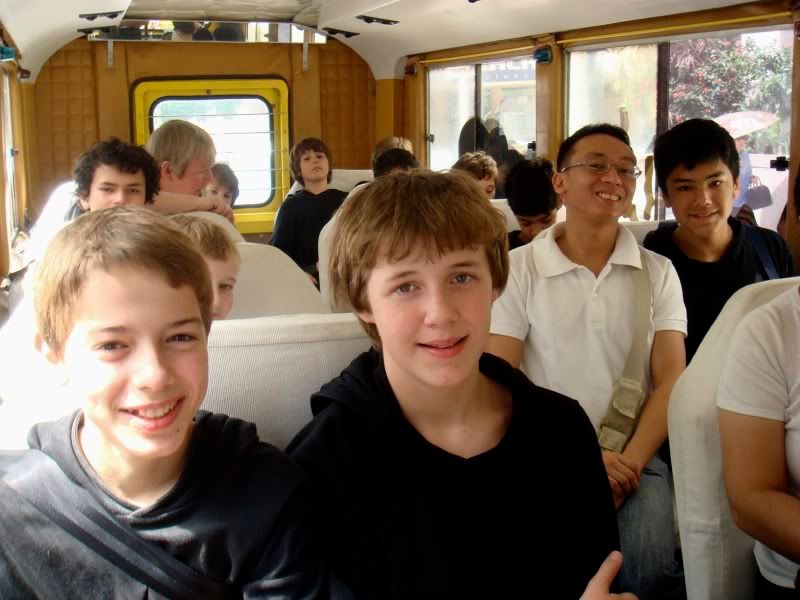
A couple of days later, Dr. Antonio Torralba and I, with the able help of a sprightly Roberto F. de Ocampo, took the angel voices behind Libera to a brisk, but entertaining tour of Old Manila. Despite their obvious fatigue after a successful concert in Cebu, the young gentlemen of Libera were more than up to the task of distilling the cultural and historical marvel that is Old Manila in two hours, one proud set of ancient walls (Baluarte de San Diego), one venerable old Cathedral (Manila Cathedral), and one strategically located handicrafts shop (Manansan). The ageless, yet age-appropriate raconteur in me believes that yours truly played a big role in making their last memories of the Philippines both an educational and pleasurable one.
Ah, if only all my late Octobers and early Novembers were quite this satisfying! Pictures of the Libera tour may be seen here. Enjoy!
"Man is more himself, man is more manlike, when joy is the fundamental thing in him, and grief the superficial. Melancholy should be an innocent interlude, a tender and fugitive frame of mind; praise should be the permanent pulsation of the soul. Pessimism is at best an emotional half-holiday; joy is the uproarious labour by which all things live...Christianity satisfies suddenly and perfectly man's ancestral instinct for being the right way up; satisfies it supremely in this; that by its creed joy becomes something gigantic and sadness something special and small."
I celebrate life. Do you?